How to Save Money on Pet Medications
The same medication can cost 30 to 60 percent more at a veterinary clinic than it does from a licensed online pharmacy. For recurring medications — flea and tick preventives, heartworm tablets, allergy relief — buying from a major licensed online pharmacy instead of a clinic typically saves 20 to 35 percent over a year (multiple price surveys in the UK and US, including the UK CMA’s 2025 veterinary medicines market investigation). The savings come from the same active ingredient, not a weaker version of it.
What you’re paying for at the clinic
Clinic pricing covers real services: keeping medications in stock, professional guidance on dosing and drug interactions, and the convenience of walking out with the product the same day. WSAVA — the World Small Animal Veterinary Association — actually recommends purchasing from the clinic pharmacy first, precisely because the veterinary team can spot dosing problems and adverse reactions in person.
This page is not an argument against your vet. It is for owners who are comfortable managing recurring medications month after month, who know their pet’s routine, and who want to know what their options are.
The safe way to buy pet medication online
Some of the biggest savings are on prescription-only drugs, which is why the legal path matters. Heartworm tablets such as Heartgard are prescription-only in the United States. A licensed online pharmacy will require that prescription — with Chewy, you add your pet and your vet’s details at checkout, and Chewy contacts your vet for you at no extra charge. Your vet may charge a small prescription fee; UK surveys put that fee between £12 and £36.
Legitimate online pharmacies share three markers: they require a prescription for prescription drugs, they display their pharmacy license, and a pharmacist is reachable for questions. The NABP’s .pharmacy accreditation and Vet-VIPPS history are the quickest external checks.
Where the savings are, by medication type
| Medication type | Prescription? | Typical online saving | Examples |
|---|---|---|---|
| Flea & tick topicals | No | 30–50% | Frontline, Advantage |
| Heartworm tablets | Yes | 30–60% | Heartgard, Interceptor |
| Allergy medications | Yes | 20–40% | Apoquel (oclacitinib) — prescription and vet monitoring required |
| Skin & joint supplements | No | 25–45% | Omega-3, glucosamine products |
| Prescription diets | Yes | 10–20% | Hill’s, Royal Canin |
The channels, compared
Five mainstream channels cover most needs:
- Chewy Autoship — 5–10% off recurring orders and free shipping over $49. The strongest option for anything you give every month.
- Amazon — list prices move around; Subscribe & Save works like Autoship.
- Costco Pet Pharmacy — membership-based, often the lowest single-unit price.
- 1-800-PetMeds — long-established, frequent promotions.
- Walmart Pet Rx — low prices on a narrower list.
What not to do
- Don’t buy “prescription” drugs from sites that don’t ask for a prescription. If a site sells Heartgard with no vet involvement, the product’s origin and storage history are unknown.
- Don’t import medications from outside the United States. The FDA’s position is unambiguous: importing medications from other countries into the U.S. is illegal, and exceptions are granted only case by case. Overseas “gray channel” sellers are not just unregulated — buying from them breaks the law.
- Don’t skip heartworm prevention to save money. Treatment for heartworm disease costs several times a year of prevention, and the treatment itself carries real risk.
The long game: chronic medications multiply the difference
Prevention is seasonal and steady; chronic medication is where the arithmetic compounds. A dog on long-term pain management (carprofen, for example) or an allergic cat on year-round medication buys the same product every month for years. At a 30–40% unit-price difference, a 5 monthly medication costs roughly 80 more per year at clinic pricing — and over a five-year treatment window, that is close to a thousand dollars for the same boxes. Chronic cases are also where autoship programs matter most, because a missed refill has real consequences and the shipping schedule removes that failure mode.
Multi-pet households: where the gap widens
Everything above scales per animal. Two dogs on year-round prevention double the clinic-versus-online gap — a two-dog household that saves 50 on one dog is saving close to 00 annually across both. The same logic applies to cats: feline prevention is cheaper per animal than canine, but the percentage difference between channels is comparable, so a dog-and-cat household typically sees the total annual saving land between 00 and 50 depending on sizes and brands. Most licensed online pharmacies treat each pet’s prescriptions separately but consolidate shipping, which keeps the logistics simple.
Pet insurance and medication plans: read the overlap
Two financial products interact with medication costs, and neither replaces comparison shopping. Accident-and-illness insurance reimburses treatment drugs after a claim — but most policies exclude preventive medications like flea, tick and heartworm products, so the retail comparison on this page still applies to them. Wellness plans sold by clinic chains discount in-house purchases but do not transfer to online pharmacies; whether one pays off depends entirely on how much of it you use. The practical sequence: check what your insurance covers, then comparison-shop everything it does not cover.
A worked example: one year of prevention
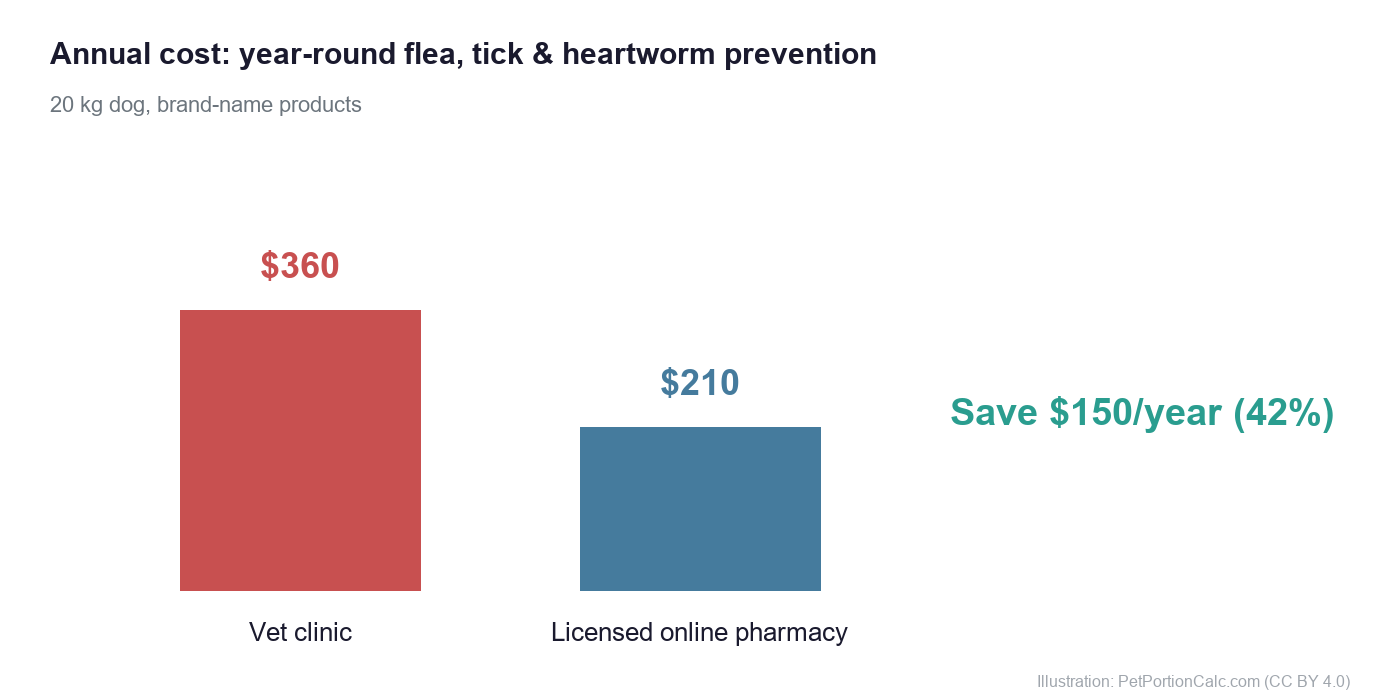
Take a 20 kg dog on brand-name heartworm and flea-tick protection for twelve months. Bought entirely at the clinic, the year runs about $360. The identical products from a licensed online pharmacy’s autoship program run about $210. The difference is $150 over one year, a 42% saving — for the same boxes, with the same active ingredients, shipped to the door.
Why prices move, and when to buy
Online pet-medication prices are not fixed. Three patterns are stable enough to plan around. First, seasonal demand: flea and tick products spike in spring, and pharmacies respond with sitewide promotions in late winter — buying the warm-season supply in February or March reliably beats buying it in May. Second, manufacturer rebates: the brands behind Heartgard and Frontline run mail-in or digital rebates several times a year, sometimes stacking with an autoship discount. Third, first-order incentives: nearly every licensed online pharmacy offers a percentage-off first order, and the discounts are transferable between pets on the same account. None of this requires coupon-hunting; a calendar reminder ahead of your normal refill date captures most of it.
Talking to your vet about online pharmacies
Some owners hesitate to raise the topic, fearing the conversation will be awkward. The workable framing is simple: ask for a written prescription at the annual visit, and say you are comparing prices for the recurring items while continuing to use the clinic for everything else. Most vets accommodate this without friction — the prescription itself belongs to the pet’s owner once written. A smaller number of practices decline to write prescriptions for patients they did not examine recently, which is their right under state pharmacy rules; an annual exam renews it. What matters for this page is that the conversation is normal, legal, and common — the clinics most used to it are the ones in areas with the most online-pharmacy users.
Frequently asked questions
Can I use a prescription from any vet at an online pharmacy?
Yes — any licensed US vet’s prescription is valid at a licensed online pharmacy. Chewy contacts the vet for you at no extra charge, though your vet may charge a prescription fee of their own.
Is online medication the same product as the clinic’s?
Yes — same manufacturer, same active ingredient. Check the manufacturer and the FDA approval number on the box: brand-name drugs carry a NADA number, generics carry an ANADA number.
How much can I actually save per year?
For a dog on year-round flea, tick and heartworm prevention, typically $120–$200 per year depending on brand and dog size.
Are generic versions worth it?
Where an FDA-approved generic exists — for example, carprofen for Rimadyl, or meloxicam for Metacam — it has the same active ingredient and is often 30–50% cheaper. Ask your vet whether a generic is available for your pet’s medication.
The bottom line
For recurring, long-term medications, buying from a licensed online pharmacy is the same product at a lower price — typically $120–$200 a year of savings for a dog on standard preventives. If you value the clinic’s in-person guidance more than the difference, buying from your vet remains a perfectly sound choice. For everyone else, the licensed online route is where the same money buys the same medicine.
Pairs well with our guides on dog weight loss and body condition scoring — both pair with regular vet visits where medication questions come up.