Cheap Heartworm Prevention: What Actually Works
Heartworm prevention is prescription-only, but “prescription” does not have to mean “vet-clinic price.” The same FDA-approved preventives — Heartgard, Interceptor, Revolution — cost 30-50% less through a licensed online pharmacy, and FDA-approved generics of Heartgard (ivermectin) cut the price further, to roughly $6-12 a month for a medium dog. The one thing that is never on the menu: skipping doses. Treatment for established heartworm disease commonly costs $1,000-2,000, and severe cases can reach $5,000 or more — many times a full year of prevention. (Prices per Chewy, Amazon and 1-800-PetMeds listings, September 2026.)
Why heartworm is the one thing you never budget-cut to zero
Fleas are uncomfortable; heartworm is fatal. The parasite is transmitted by a single mosquito bite, matures into foot-long worms that live in the heart and lungs, and treatment is not a pill — it is a series of deep muscle injections of an arsenic-based drug, strict exercise restriction for months (because dying worms can cause lethal embolisms), and a bill that commonly runs $1,000-2,000, with severe cases reaching $5,000 or more. In cats there is no approved drug that kills adult heartworms — treatment is limited to managing the symptoms and complications — so prevention is the only option.
Set against that: a full year of prevention costs $72-144 for most dogs on a basic preventive; combination products (heartworm + fleas + ticks) cost more. Prevention is not a wellness expense; it is insurance with a 100% payout rate when the alternative is considered.
The preventives that actually work (and their real prices)
Four prescriptions cover nearly every legitimate product on the shelf:
| Product | Active ingredient | Covers | Annual cost (online) | Rx? |
|---|---|---|---|---|
| Heartgard Plus (brand) | Ivermectin + pyrantel | Heartworm | $100–144 | Rx |
| Heartgard generics (Iverhart, Tri-Heart) | Ivermectin + pyrantel | Heartworm | $72–100 | Rx |
| Interceptor Plus | Milbemycin + praziquantel | Heartworm + tapeworm | $70–110 | Rx |
| Revolution | Selamectin | Heartworm + fleas | $180–300 (cat) / $110–180 (dog) | Rx |
| Simparica Trio | Sarolaner + moxidectin + pyrantel | Heartworm + fleas + ticks | $150–240 | Rx |
The generic math: ivermectin-based generics of Heartgard (Iverhart, Tri-Heart and store brands) are FDA-approved, contain the same active ingredients at the same doses, and typically run $6-12 a month for a medium dog depending on weight and pack size — small dogs at the lower end, larger breeds toward the top. The two most common generics, Iverhart Plus and Tri-Heart Plus, are widely available. Simparica Trio, as one of the newest combination products, does not yet have a generic, which is why combination coverage remains the premium tier. (Prices per Chewy, Amazon, 1-800-PetMeds listings, September 2026.)
The four legitimate ways to pay less
- Ask for the generic by name. Say “is there an FDA-approved generic of Heartgard for my dog?” — Iverhart Plus and Tri-Heart Plus are the two most common. Same dose schedule, same monthly chew.
- Buy 12-month supplies. 12-packs are usually priced below buying 12 single doses separately, and autoship stacking takes another 5-10% off at Chewy.
- Use the prescription the smart way. Chewy contacts your vet for you at checkout at no extra charge — the same flow as our flea and tick guide describes. Ask for a written prescription at the annual visit and you own it for a year (your vet may charge a small prescription fee, as with any written Rx).
- Watch for the rebates. Heartgard and Revolution run “buy 12 get rebates” several times a year; combining a rebate with a generic is not possible (rebates are brand-only), so pick one: generic pricing usually beats the brand’s post-rebate price.
Cats — the species where prevention is the only option
Cats get heartworm from the same mosquitoes, and the disease is worse news: there is no approved drug that kills adult heartworms in cats — treatment is limited to managing the symptoms and complications (corticosteroids, oxygen therapy and supportive care), and the sudden respiratory crises (“heartworm-associated respiratory disease”) can appear without warning. Studies cited by the American Heartworm Society have found that roughly 1 in 4 infected cats lived exclusively indoors.
Feline prevention is comparatively affordable through the generic route too — selamectin-based products (Revolution, or a generic if one is available for your cat) run roughly $15-25 a month — and it is the same licensed-online-pharmacy route: prescription verified through the checkout flow, autoship discount applied.
What not to do
- Split dog doses across pets or across months. Ivermectin dosing is weight-specific; a “half dose every other month” schedule is a protection gap, not a saving — and a dog dose of some combination products can harm a cat.
- Buy from overseas sellers. The FDA’s position is unchanged: importing medications into the US is illegal outside narrow case-by-case exceptions.
- Skip the annual heartworm test to save $25-45. The test is what makes prevention safe to continue — starting a preventive drug in a dog that already has adult worms can trigger a dangerous reaction, so the annual blood test is not an upsell; it is a safety requirement.
- Rely on “natural” mosquito repellents alone. No herbal product has FDA evaluation for heartworm prevention; the protection gap is real and the disease is unforgiving.
A worked example — one year, three routes
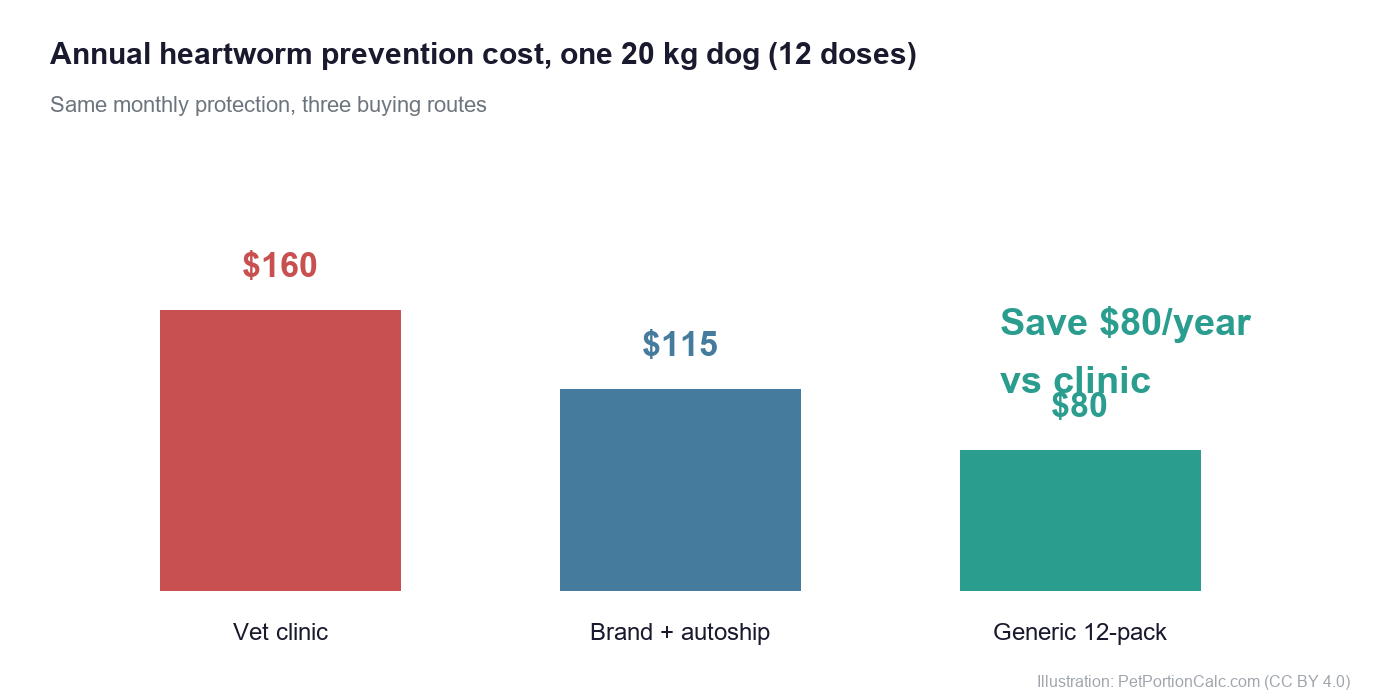
A 20 kg dog, twelve monthly heartworm doses:
| Route | Annual cost | Notes |
|---|---|---|
| Vet clinic, brand product | ~$160 | Convenience premium |
| Brand product, licensed online + autoship | ~$115 | Same chews, channel saving |
| FDA-approved generic, online 12-pack | ~$80 | Same ivermectin dose, deepest saving |
The generic route saves about $80 a year — and every dollar of it stays protection. The annual heartworm test ($25-45) is the one line worth keeping at full price.
Frequently asked questions
Is generic Heartgard as safe as the brand?
FDA-approved generics (Iverhart Plus, Tri-Heart Plus) contain the same ivermectin and pyrantel at the same doses and pass the same bioequivalence standards. Vets prescribe them routinely.
Why is heartworm prevention prescription-only if it is so safe?
Because prevention must not be started without a negative heartworm test — treating a dog that already has adult worms can cause a severe reaction. The prescription is the safety gate, not a price mechanic.
Do indoor cats really need heartworm prevention?
Studies cited by the American Heartworm Society have found that roughly 1 in 4 infected cats lived indoors only. There is no approved drug that kills adult heartworms in cats — treatment is limited to managing symptoms — so monthly prevention is the only line of defense.
What does heartworm treatment actually cost?
Commonly $1,000-2,000 for the injection series, exercise restriction and follow-up testing, with severe cases reaching $5,000 or more — many times the cost of a year of prevention. Cats have no approved adulticide treatment at all.
The bottom line
Heartworm prevention is the one pet expense where the cheapest option and the correct option are the same thing: a monthly FDA-approved preventive, bought through a licensed pharmacy, with the annual test kept at full price. Generics bring a medium dog’s year down to about $80; skipping it risks a four-figure treatment and months of crate rest.
Related: our medication savings guide explains the prescription-verification flow, flea & tick on a budget covers the other year-round preventive, and body condition scoring keeps the dosing weight honest.