kcal/cup or kcal/kg: which number on the bag do you use?
By Josh · Reviewed and updated: 2026-09-17
For the practical version of this conversion — what one cup actually contains — see calories per cup of dog food.
kcal/kg and kcal/cup are two different units, not a decimal-point move: a bag saying 3,700 kcal/kg and 370 kcal/cup is consistent, because a cup weighs about 100 g. Entering one where a calculator expects the other is a common mistake — the page shows how to tell them apart.
Pet food labels print the calorie content twice, and the two figures often look like the same number with the decimal point moved. A bag might say 3,700 kcal/kg and 370 kcal/cup — and those really are consistent with each other. But enter 3,700 where a calculator expects a per-cup figure, or 370 where it expects per-kilogram, and you get an answer ten times too large or too small. This page is about telling them apart.
The two units, and what each one is for
| On the label | Means | Use it when |
|---|---|---|
| kcal/kg | Calories in one kilogram of food, by weight | You are weighing food in grams. This is the unit most labels lead with outside the United States, and it is the more precise of the two. |
| kcal/cup | Calories in one measuring cup of food, by volume | You are scooping with a cup and not using a scale. Common on US packaging. |
| kcal per 100 g | Calories in 100 grams of food | You see it on European labels. It is simply kcal/kg divided by 10. |
They are not competing measurements. They describe the same food, in different amounts of it. The reason they cause trouble is that a calculator has to be told which one you are giving it, and the numbers are similar enough that a mistake does not look like one.
Why the error is tenfold, and why it is silent
Most adult dry food sits between 3,000 and 4,500 kcal/kg, which is 300 to 450 kcal per 100 g. Notice the pattern: the per-kilogram figure and the per-100-gram figure differ by a factor of ten, and only look like the same digits.
So 3,700 kcal/kg is 370 kcal per 100 g. Put 3,700 into a field that wanted a per-100-gram figure and the calculator believes the food contains 3,700 kcal per 100 g — ten times more energy than it does — and will tell you to feed a tenth of the correct amount. Put 370 into a field that wanted kcal/kg and it will tell you to feed ten times too much.
Converting between them
kcal/kg to kcal per 100 g: divide by 10. That is the whole conversion, and it needs no other information.
kcal/kg to kcal/cup: you also need the weight of a cup. This is where a second number comes in, because a cup is a volume and kibble density varies:
For a food of 3,700 kcal/kg at 110 g per cup: 3,700 ÷ 1000 = 3.7 kcal per gram, × 110 = 407 kcal/cup. That is why the same bag can look like 370 kcal/cup on one product and 407 on another — the calorie density is the same only if the cups weigh the same.
If the label gives kcal/cup but not grams per cup, you can measure it once: put a measuring cup on a kitchen scale, tare it, fill and level the cup, and weigh it. The cups per pound page covers that in more detail.
Converting the other way: from kcal/cup back to kcal/kg
The reverse direction matters more than you might expect, because a lot of US packaging only prints the per-cup figure — there is no kcal/kg number on the bag at all. To get one, you still need the weight of a cup:
For a food labelled 407 kcal/cup at 110 g per cup, the calculation is two steps: 407 × 1000 = 407,000, then 407,000 ÷ 110 = 3,700 kcal/kg — the same number the label would print in the metric column.
The uncertainty also runs in the same direction. The per-cup figure inherits the measurement error of a cup — how finely a kibble packs, how rounded the particles are. That is why the per-kilogram figure, where a label provides one, is the more trustworthy of the two, and why the calculator on the home page lets you work in either unit but shows the daily amount in grams.
Which one should you actually use?
Use whichever your calculator asks for, and change the calculator's unit selector to match the label — not the other way round. Both units give the same answer once they are entered correctly:
- If you weigh food in grams — which is the more accurate way to feed, and the only sensible way for a cat — use kcal/kg or kcal per 100 g. Then the answer does not depend on how tightly a cup happens to be filled.
- If you scoop with a cup, use kcal/cup, and enter the bag's grams-per-cup value if it has one.
- If the label gives only one of the two, convert it. kcal/kg ÷ 10 gives the per-100-gram figure directly, and the per-cup figure needs only the weight of a cup.
Our calculator accepts either unit: pick kcal/cup or kcal/kg from the dropdown beside the calorie field, and it does the rest. The label-reading page covers the rest of the calorie statement — where it sits on the pack, what else is printed there, and what the guaranteed analysis does and does not tell you.
Converting between units is easier with a scale. Browse digital kitchen scales on Amazon — weigh one cup of your food and the calculator does the rest.
Affiliate disclosure: we may earn a commission on purchases made through links on this page, at no extra cost to you.
Frequently asked questions
My bag only shows kcal/cup — there is no kcal/kg anywhere. What do I do?
Use the reverse conversion above: kcal/kg = (kcal/cup × 1000) ÷ grams per cup. You need the grams-per-cup figure, which many US brands print in the feeding guide (look for a line like “1 cup = 110 g”). If your bag does not print it either, switch the calculator to kcal/cup mode and enter the per-cup figure directly — the answer will be expressed in cups, which matches the only unit your bag gives you.
Why do two products from the same brand list different kcal/cup values?
Because kcal/cup measures a volume, and different recipes pack differently: a small, dense pellet settles tighter into a cup than a large, airy one, so the same physical cup holds more food and more calories. The kcal/kg figure stays comparable across recipes because it is measured by weight. This is why two products can both be “370 kcal per 100 g” yet print different per-cup numbers.
Is weighing food really more accurate than using a cup?
Yes, and the reason is the same volume problem. Measuring-cup studies have found owners can be off by 50% or more in either direction depending on how loosely or tightly the cup is filled, and nobody levels a cup the same way twice. A kitchen scale reads grams directly, so the same portion weighs the same every time. That is why the calculator shows its daily answer in grams first, and why cats — whose portions are small enough that a cup's error matters most — should always be fed by weight.
The label says “Metabolizable Energy (ME)”. Is that the same kcal figure?
Yes. The calorie content printed on pet food labels — whether per kilogram, per cup or per treat — is the metabolizable energy content: the energy left after accounting for energy lost in faeces and urine. It is the standard measure pet food labelling uses, and it is the number the calculator expects. There is no separate conversion needed; kcal on a pet food label means ME kcal.
My bag says 3,700 kcal/kg. What do I type into a calculator that wants kcal/cup?
Do not type 3,700 into a per-cup field. Either switch the calculator's unit selector to kcal/kg and type 3,700, or convert first: 3,700 kcal/kg is 370 kcal per 100 g, and the per-cup figure is (3,700 ÷ 1000) × grams per cup. At 110 g per cup that is about 407 kcal/cup.
Is kcal/kg the same as kcal per 100 g?
No — they differ by a factor of ten. kcal per 100 g is kcal/kg divided by 10, so 3,700 kcal/kg is 370 kcal per 100 g. Mixing them up is the single most common error in home portion calculation, because the two numbers look equally plausible.
Why does my bag give two different calorie numbers?
Because they are measured in different quantities of food, not because one is wrong. kcal/kg measures a weight of food; kcal/cup measures a volume. Both are correct, and they are consistent with each other once you know how much a cup of that particular food weighs.
Which is more accurate?
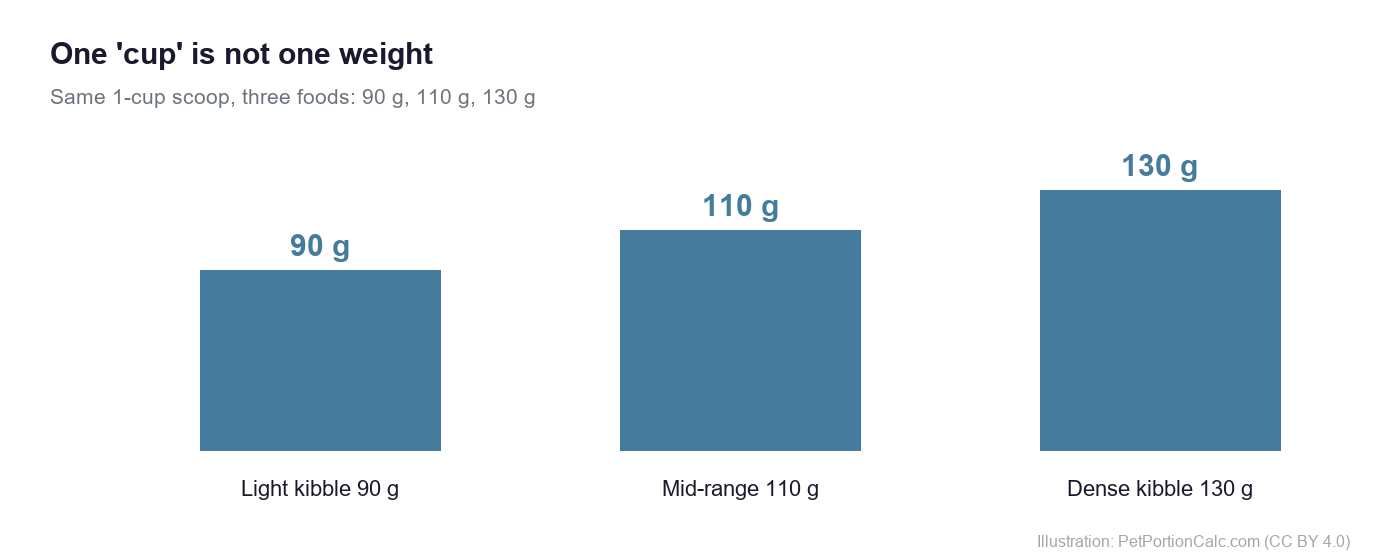
Feeding by weight. A cup is a volume, and the same cup can hold 90 to 130 grams of kibble depending on the food, so a cup-based figure carries that variation with it. A gram figure does not.
What does kcal/cup mean?
It is the calorie density of the food measured by volume — how many kilocalories are in one measuring cup of that kibble. Because a cup is not a fixed weight, kcal/cup is only meaningful alongside a grams-per-cup figure for your specific food. To convert it to the weight-based unit: kcal/kg = kcal/cup × 1000 ÷ grams per cup. Both units are explained in The two units, and what each one is for · Source: every number can be re-computed.
Where to find the calorie figure on the label →
Calculate the daily amount in grams or cups →
Recently neutered? The amount has to change →
How much does a cup of your food weigh? →
The two units are not interchangeable, and confusing them costs you real accuracy
kcal/kg describes the food. kcal per cup describes a serving — and a serving is a volume, so it depends on how much a cup of that particular kibble weighs. The relationship between the two is exactly one number: grams per cup.
This is why a label can look “lower calorie” and still deliver more energy per meal. A food at 3,400 kcal/kg with a dense 130 g cup gives 442 kcal per cup; a food at 4,000 kcal/kg with a light 100 g cup gives 400. The denser-looking number is the lower-energy serving. Comparing across units without the cup weight is comparing nothing.
What this page cannot do: it cannot tell you grams per cup for your food. That is a physical measurement — zero a kitchen scale with the cup on it, fill level, weigh. It takes two minutes and it is the single most useful number you can write on a bag.
How this page was checked: Numbers traced to NRC (2006), WSAVA and AAHA guidance; units re-derived independently; safety statements limited to the species they were established for. Our review method
Primary references
- AAFCO — consumer resources on pet food labels. How kcal/kg and kcal-per-cup statements are defined and required on labels. aafco.org/consumers
- MSD Veterinary Manual — Nutrition, Small Animals. Metabolisable energy density and how it is expressed. msdvetmanual.com
- Tufts University, Cummings School of Veterinary Medicine — Petfoodology. Why serving-based figures cannot be compared across different foods. sites.tufts.edu/petfoodology